scpmkj@gmail.com
Get A Free Quote
 share
share
Warehouse logistics complement: Most manufacturing companies focus on coding in the circulation link that is easy to ignore in many factories. Complete the assignment of production date, batch number, and QR code on the production line to realize "code assignment immediately after delivery".
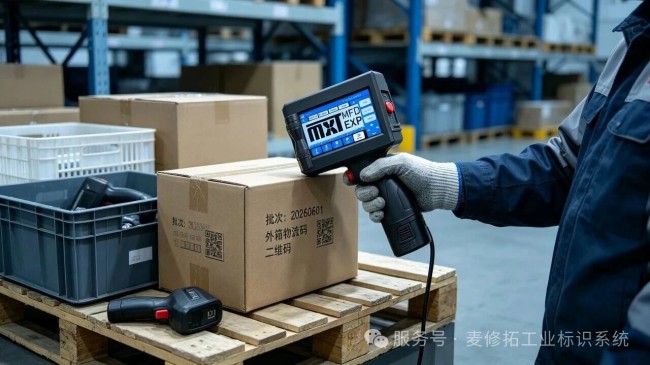
However, after the goods are put into storage and transferred to the warehouse, turnover, and distribution, there will always be various problems in assigning codes: fuzzy and missing identification of the supplier's incoming materials, code in the inner box and no code in the outer box, rectification of return and replacement packages, cross-regional shipments require distribution anti-smuggling codes, and temporary changes in orders require revision of logos...
The warehousing and logistics complement means temporarily or systematically marking the transfer boxes, cartons, and outer boxes with batches, serial numbers, dates, QR codes, etc. at the warehouse site. It is not the same as fixed coding on the production line. Its core features are mobile, flexible, and ready-to-use, and there is no need to go through the production line again.
With the popularization of WMS warehousing management, TMS transportation management, and one-item-one-code traceability systems,"boxes have codes and pieces can be traced" has gradually become the industry standard. Warehouse complement has changed from occasional emergencies in the past to daily operations in the warehouse.
1. Five high-frequency complement complement business scenarios
When the incoming materials of the supplier are added to the warehouse, there is no code or the original code is not worn out. The SKUs and batch codes are added on the warehouse management site to ensure the smooth shelves and inventory of the goods.
The logistics code of the outer box has been reprinted and the inner packaging has been assigned, but the outer box lacks identification. In the outbound review and logistics handover process, the logistics QR code is reprinted on the outer container to open up the warehouse-logistics data link.
After returning goods, re-packaging, re-packaging, re-printing the production date, expiration date, and traceability serial number after re-packaging, re-printing to meet compliance ex-warehouse requirements.
The anti-smuggling area code is supplemented with the same SKU and sent to different distribution areas. The area code and distribution code are supplemented on site to link the anti-counterfeiting system to achieve channel cross-smuggling control.
Temporary change order information changes, label printing errors, direct complement correction on site to prevent goods from being returned to the production line for rework, saving time and cost.
The underlying principle of complement: the spray printed logo must be clear, can be scanned and recognized, and be resistant to handling and wear. Blurring the invalid code will instead increase the workload of warehouse inventory and review.
2. Different carrier complement pain points and equipment selection
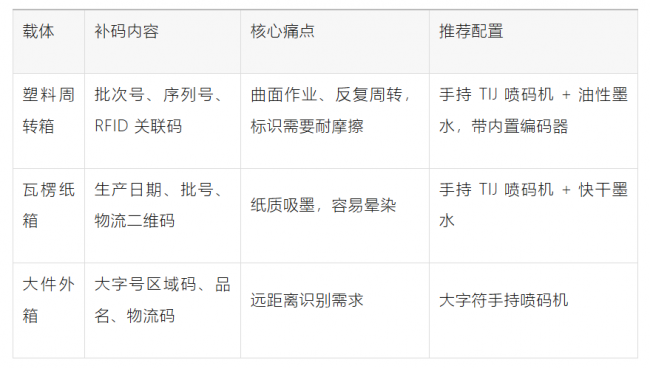
Warehouse complement carriers are mainly divided into three categories: turnover boxes, cartons, and large outer boxes. The materials are different, and the pain points and ink solutions are different.
Handheld VS online inkjet printer, how to choose a complement scenario
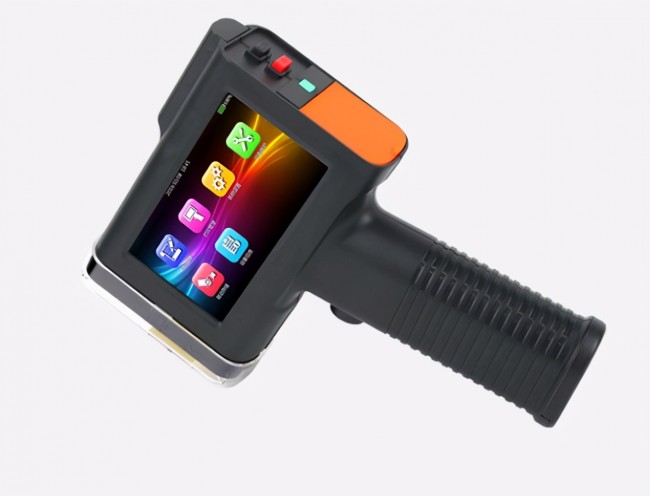
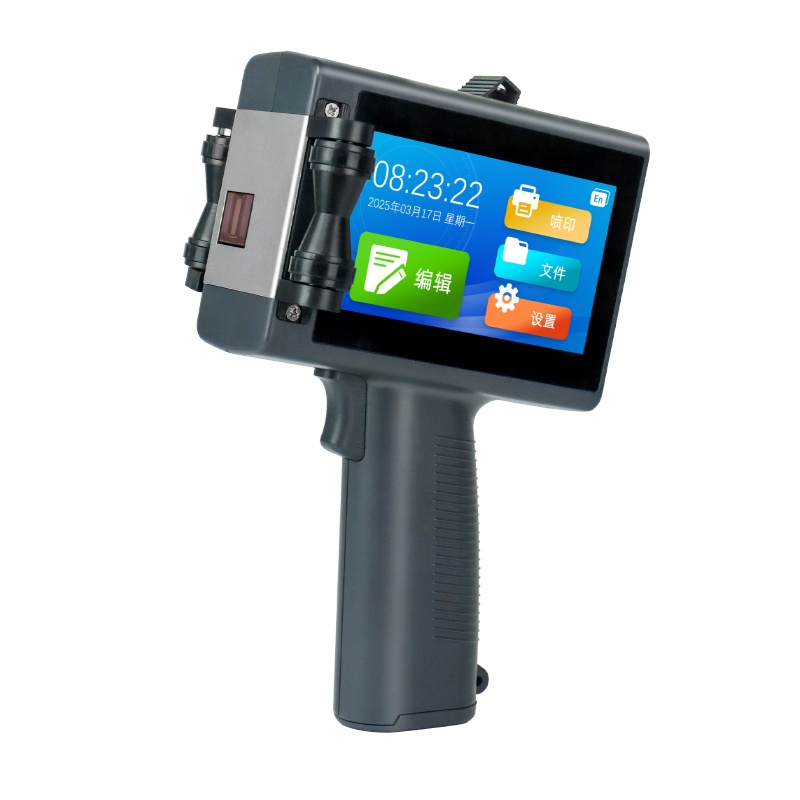
Hand-held TIJ inkjet printer works manually and prints as you go; lithium battery power is supplied without a fixed workstation; low investment cost, suitable for warehouse flipping and scattered complement; the printing speed is up to 60m/min.
The online inkjet printer is fixed on the production line and is only suitable for continuous code assignment from the factory; it requires power connection and production line transformation. The initial investment is high and it cannot be moved.
The optimal combination plan: Handheld TIJ inkjet printer serves as the main force of warehousing complement, large-character handheld machine handles the large character requirements of outer boxes, and online inkjet printer undertakes code assignment from factory production lines.
The Maxtek MXT handheld TIJ inkjet printer is about 620g, held in one hand, has a large-capacity lithium battery, suitable for warehouse keepers to move around all day long;600dpi high resolution, adjustable printing height of 2.5‑25.4mm, built-in encoder, curved surface printing will not be stretched and deformed.
3. The content of the complement is not typed casually, but must take into account manual reading + system docking.
The complement is not just printed text, but the output content must be recognized by the scanning equipment and WMS system:
Batch No.: The format is recommended as "Year, Month, Month, Year + Production Line/Shift" to support batch recall traceability;
Serial number/unique code: one object and one code underlying data. It is recommended to add check bits;
Production date & expiration date: required items for compliance in the food, medicine, and daily chemical industries;
QR/DataMatrix QR code: Connect with WMS and one-object-one-code platforms, and give priority to GS1 standards;
Regional distribution code: used for anti-smuggling control, and can be linked to anti-counterfeiting code solutions.
The equipment supports the import of external variable data, without manual entry one by one, ensuring batch complement efficiency.
4. List of warehouse complement compensation for landing pit avoidance
Pit 1: QR code printing is blurred, scanning code recognition fails
Countermeasures: Select a 600dpi high-resolution handheld device and regularly calibrate the nozzle; reserve enough quiet areas for the QR code, take real samples before batch work, and use a scanner to measure the reading rate.
Pit 2: Poor ink adhesion, and the logo falls off after handling, rubbing and wiping
Countermeasures: Match inks according to materials, select oily inks for plastic turnover boxes, and select quick-drying inks for corrugated boxes; conduct friction, alcohol wiping, and freezing environment adhesion tests before being officially put into production.
Pit 3: The curved surface transfer box is sprayed, and the content is skewed and stretched
Countermeasures: Select a handheld model with a built-in encoder to automatically synchronize the speed of mobile jet printing.
Pit 4: The warehouse has insufficient battery life for long-term operations
Countermeasures: Choose a large-capacity lithium battery model so that you can rotate spare batteries for high-intensity operations.
Pit 5: The format is confusing and it is impossible to connect to the storage system
Countermeasures: Standardize batch and serial number output formats, import standardized variable data, and try to avoid handwritten free text.
5. Maisutuo MXT warehousing and logistics complement complete plan
▪ˇ MXT handheld TIJ inkjet printer 600dpi high resolution, 60m/min printing speed, 2.5‑25.4mm printing height; the whole machine is about 620g, built-in encoder suitable for curved surface printing, large-capacity lithium battery, suitable for transfer boxes, cartons, and outer boxes on-site complement.
▪ˇ The large-character handheld inkjet printer outputs large-size logistics codes and area codes for the outer boxes of large parts, which are clearly readable from a long distance.
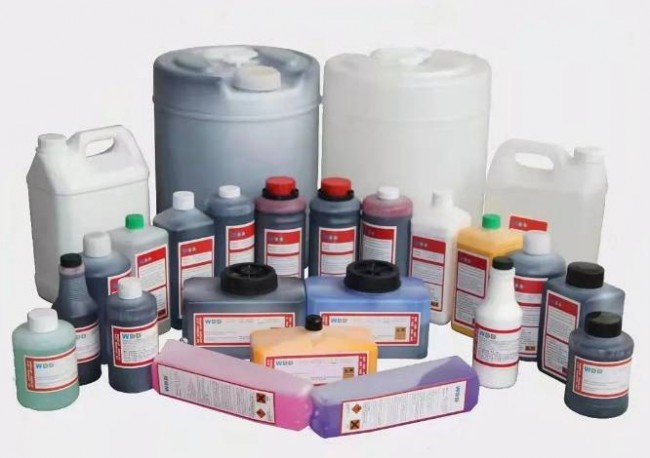
▪ˇ Various types of ink systems, water-based inks (ordinary cartons), quick-drying inks (corrugated cartons anti-smudging), oily inks (plastic turnover boxes are resistant to friction); the logos have been tested by friction, alcohol, and freezing, and are suitable for storage and cold chain. Various environments.
▪ˇ Data docking capabilities support RS232/485 and TCP‑IP communications, and variable data can be connected to WMS and one-object-one-code traceability platforms.
Q&A| Selected 8 Questions on Storage Complement
Q: What is the difference between warehousing complement code and production line code coding? A: Production line coding is continuous code assignment on the factory assembly line; warehousing complement is on-site mobile and supplementary printing in circulation links such as warehousing, package turning, outer boxes, and anti-migration. The core is flexible and ready to use.
Q: Can I use only one equipment for turnover boxes, cartons and outer boxes? A: The handheld TIJ can cover three types of carriers; the outer box requires long-distance large font sizes. It is recommended to use it with a large character handheld machine and replace the corresponding ink to adapt to different materials.
Q: What should I do if carton code is always stained? A: Corrugated paper has strong water absorption. Use quick-drying ink and high-resolution nozzle to reduce the probability of blooming.
Q: Can the QR code generated by the complement complement be connected to the WMS system? A: The QR code conforms to the general GS1 standard and has a definition up to standard. It can be recognized by the industrial scanner and WMS. You must make physical proofing tests in advance.
Q: Can the handheld phone be enough for a whole day of warehouse operations? A: The MXT handheld is equipped with a large-capacity lithium battery, which can support all day work; it is recommended to prepare spare battery rotation for high-intensity work.
Q: How to solve the problem that the code coding of plastic turnover boxes is easy to erase? A: Do not use water-based inks, choose oily inks, and complete the rubbing alcohol adhesion test before going online.
Q: How to use a handheld phone to type the anti-smuggling area code? A: The equipment imports variable data from different areas, and supplements the distribution area code at the shipping site, which can be linked with the anti-counterfeiting plan.
Q: How to ensure that the complement content format is standardized? A: Unify the format of date, batch, and serial number, import standardized variable data on the upper computer, and avoid handwritten text.
Summary at the end of the article
The warehousing and logistics complement each other, opening up a closed loop of code assignment from factory production lines to warehousing and circulation. Priority combination of equipment selection: handheld TIJ inkjet printer is the main one, large-character handheld is the auxiliary one, and online inkjet printer is responsible for factory code assignment. Only by selecting the right ink, standardizing the coding format, and doing a good job in preliminary proofing tests can we truly implement warehouse traceability, prevent smuggling of goods, and turn over and rectify the business.
Maisutuo MXT handheld inkjet printer, high-resolution, built-in encoder, and multiple inks options, provides one-stop solutions to various on-site complementary requirements for warehousing and logistics.